
Key Takeaways
-
Fractional CMO for event venues A fractional CMO provides event venues with senior marketing leadership on a part-time or contract basis, offering strategic guidance and instant experience without the expense of a full-time executive.
-
Hire a fractional CMO to scale marketing up or down, plug interim leadership holes, and bring strategies up to date with proven playbooks and cross-industry insights.
-
Anticipate cost effectiveness through project or retainer pricing, superior ROI from focused marketing spend, and reduced overhead compared to constructing an in-house executive team.
-
Get vendor and media networks for sponsorships, partnerships, and advanced tools that enhance campaign reach and revenue with a fractional CMO.
-
Deliverables should include an infrastructure audit, channel alignment, sponsor packages, yield optimization, and measurable KPIs to track performance and guide day-to-day execution.
-
Follow a structured hiring process that assesses needs, interviews against a clear scorecard, and defines contract terms with scope, metrics, and review intervals for accountability.
Fractional CMO for event venues – a part-time marketing leader who designs and executes growth strategies. They provide tangible expertise in brand positioning, digital ads, and event promotion and cost less than a full-time executive. Small and mid-size venues get improved booking velocity, more revenue per event, and greater customer clarity. Part-time, contract leadership allows teams to maintain control while gaining senior-level marketing guidance. Describe the hiring process and pricing models in the main body.
Definition
My definition of a fractional chief marketing officer is a part-time or contract-based chief marketing officer who provides executive-level marketing leadership without the cost of a full-time hire. Typically, this position involves 10 to 20 hours a week of senior leadership, sold on a monthly retainer. This model enables event venues to access senior marketing talent and tap an experienced marketing executive for strategy, team management, and tangible results without the overhead and commitment of a full-time CMO.
A fractional CMO offers specialized expertise and marketing strategies tailored to an event venue’s growth phase. For venues, this can involve designing audience segmentation for corporate clients versus social events, pricing and packaging for weekdays versus weekends, and identifying marketing channels that drive qualified leads, such as search, planner partnerships, or niche tradeshows. The fractional CMO aligns marketing activity with business goals, ensuring that every campaign has a clear aim: increase site visits that convert to tours, boost off-peak bookings, or grow long-term corporate contracts.
Hiring a fractional CMO is inherently flexible, allowing venues to engage their services for specific projects, like launching a new product or during a growth phase post capital raise. Many engagements begin after a Series A funding round when venues have the capital to scale customer acquisition but lack the maturity to invest in building an internal marketing department. Standard engagements are on retainer and can be adjusted as needs evolve, serving as stopgap leadership during CEO transitions or while searching for a full-time replacement.
The fractional CMO fills leadership gaps and modernizes current marketing practices. They establish quantitative structures, such as attribution, KPIs, and reporting, while directing individuals and partners responsible for implementation. In practice, this means running data analytics to show which ad spend and referral partners generate qualified opportunities, creating repeatable campaign templates for venue tours, and coaching in-house teams or marketing agencies to enhance conversion rates. By the end of the first quarter of a well-managed engagement, attribution typically has been established, campaigns are generating qualified leads, and marketing’s contribution to revenue is measurable for the first time.
Price and results-centric. A fractional CMO can reduce leadership expenses by more than 60% relative to a full-time executive’s loaded salary. The typical U.S.-based full-time CMO makes more than $200,000 a year, not including equity and bonuses. Fractional leaders provide three core things many growth-stage venues lack: strategic direction, leadership of teams and partners, and accountability for marketing-driven results. Adding recruiting time and onboarding allows venues to sidestep losing close to a full year of a three-year cycle to transitions with a fractional CMO.
Key Benefits
Fractional CMOs provide executive marketing leadership without the overhead of hiring full-time, offering affordable access to senior talent. They deliver an actionable, written strategy that prioritizes critical factors and ranks repairs by monetary impact. This plan typically identifies slow follow-up, forms that request too much information, and leads sitting in the CRM without an owner, ultimately enhancing the marketing department’s efficiency. These fixes lower cost per qualified opportunity and can shorten sales cycles, pulling revenue into earlier months rather than pushing it out into the next year.
Cost Efficiency
|
Item |
Fractional CMO (retainer/project) |
Full-time CMO (salary + benefits) |
|---|---|---|
|
Annual cost (example) |
30,000–120,000 EUR |
180,000–300,000 EUR |
|
Time to payback (typical) |
4–11 months |
12–24 months |
|
Flexibility to reallocate budget |
High |
Low |
|
Immediate impact on pipeline |
Fast |
Slower startup |
Retainer or project models allow venues to align spend with need, particularly in the context of business growth. A project-based engagement can address lead-flow fixes initially and then scale into brand and demand strategies. With budget unencumbered from fixed payroll, venues can invest more in quantifiable activities such as paid media, CRM work, or events. A fractional chief marketing officer frequently drives better ROI by boosting qualified opportunities and increasing close rates, showcasing the effectiveness of a tailored marketing approach.
Strategic Agility
-
Get into new markets when demand spikes, such as seasonal tourism and conference seasons.
-
Go up for big event bookings or down for off months.
-
Pivot messaging quickly during public-health or travel disruptions.
-
Introduce new offerings such as hybrid streaming or in-person catering.
Strategic agility counts when venues encounter rapid shifts in the market landscape. A fractional chief marketing officer can move faster than a hire, shifting channels, budgets, and creative in weeks, not months. They introduce battle-tested playbooks from other industries, aiding in the development of new marketing strategies for ticketing, sponsorship sales, or corporate bookings. I suggest enumerating specific venue situations where nimbleness saves lost income and protects reputation.
Network Access
A fractional CMO comes with proven vendors, agencies, and media partners waiting to connect. That network makes campaigns launch quickly and frequently cuts vendor search time and expense. Leverage these relationships to secure sponsorships, co-marketing deals, and earned media that would take an internal team longer to develop.
Access to cutting edge tools and platforms through partner relationships so you can track qualified leads faster and create cleaner marketing to sales hand offs. Aggregate potential partners and tech stacks the CMO can bring to measure impact and scale.
Venue Challenges
Event venues exist in a fluid market landscape with fluctuating demand, increasing client expectations, and an operational grind that restricts time for strategy. Venues are busy balancing client requirements for the right space, impeccable event execution, and budget with staff managing bookings, operations, finance, and marketing. With limited in-house marketing resources, it’s difficult to aggressively pursue business growth, experiment with marketing channels, or keep messaging consistent across channels. With so many channels—digital ads, social, email, partners, and offline PR—fragmentation abounds and dilutes impact without a clear strategy. Strategic marketing leadership is needed to prioritize, measure return on investment, and align tactics to both revenue goals and operational capacity.
Seasonality Drops
-
Provide weekday and shoulder-season bookings with off-peak bundles.
-
Host mini-themed series, such as workshops and pop-up markets, to draw in local foot traffic.
-
Team up with local businesses for co-marketed events and cross promotion.
-
Introduce pre-booking discounts and loyalty programs for return customers.
-
Use venue space for short-term rentals, such as film shoots, rehearsals, and coworking.
-
Run ads targeted at corporate clients who want training or meetings.
Develop targeted marketing strategies that reframe off-peak value: promote intimacy, customization, and cost savings to corporates and private clients. Segment messages by wedding parties, product launches, and community groups so promos resonate and are timely. Start with your historical booking data and then incorporate outside signals, such as local event calendars, school schedules, and tourist flows, to predict demand and map out promotions months in advance. Data analytics allow managers to foresee low windows and experiment with promotions that optimize business growth. Other time-tested options include bundles of services, creative pricing, and partnership arrangements that cross-share audiences and cut marketing costs.
Empty Calendars
Empty calendars typically come from poor lead follow-up, fuzzy positioning, or failure to reach out to new segments. Blank dates drive down income and add stress to making monthly numbers, which impacts budgets and team morale. Use marketing automation and CRM to capture inquiries and score leads. Run nurture campaigns that keep prospects engaged. Automations can deliver personalized follow-ups, propose dates, and provide limited-time offers to close potential leads.
Proactive outreach helps target event planners, production companies, and local institutions with tailored pitches. Build a checklist to fill calendars by auditing lead sources, setting SLA for follow-up, creating time-limited offers, repurposing spaces for alternate uses, and running referral incentives for past clients.
Channel Fragmentation
Multiple platforms generate fragmented messaging and wasted spend when uncoordinated. Fragmentation conceals performance gaps and confuses customers faced with inconsistent brand messages. Work marketing plans in digital, social, email, partners, and local media all together to keep messages coordinated.
Map current channel use, record audience overlap and identify coverage gaps. Venue challenges include segmenting and easy analytics to drive spend where bookings originate. A centralized content calendar, shared KPIs and regular channel check-ins keep brand voice consistent and ROI on the rise.
Strategic Deliverables
A fractional chief marketing officer engagement for event venues focuses on strategic deliverables that connect your marketing efforts to bookings, revenue, and sustainable business growth. This collaboration begins with establishing ownership, analyzing current marketing strategies, and defining budget decisions. The core deliverables and expected outcomes checklist includes detailed actions across five program areas to ensure effective market entry and competitive advantage.
1. Audit Infrastructure
Begin with a complete audit of marketing systems, tools, and processes to identify gaps and waste. Evaluate digital platforms, CRM infrastructure, email, booking engines, analytics tags, and marketing stack integration. Look at strategic deliverables. Examine how data flows from lead capture to contract and if attribution is captured.
Audit team positions and competencies to identify requirements for updating or automated Pinpoint manual handoffs that delay responses to leads. Make an infrastructure audit checklist — things like CRM health, tag consistency, platform logins, API links, data retention, training gaps. Expected outcome: a prioritized remediation plan, a three-phase timeline, and a baseline for a 90-day diagnostic.
2. Align Channels
Coordinate paid, owned, and earned channels so brand messages are consistent and complement venue positioning. Map customer journeys from discovery through site visit to contract signing, incorporating digital touchpoints, phone, onsite tours, and referral paths. Consult the map to verify messaging and calls to action align at each stage.
Build a cross-channel plan that defines cadence, creative themes, audience targets, and success measures. Create a matrix of channels, priority, budgets, and team members responsible. Results encompass integrated brand messaging, less confusion for purchasers, and initiatives that yield qualified leads for the sales funnel.
3. Secure Sponsors
Locate sponsor categories that match the venue’s audience, such as local hospitality brands, beverage companies, tech partners, trade associations, and experiential vendors. Leverage a fractional CMO’s network to open doors and negotiate premium deals. Create sponsor packages that show clear ROI, including audience demographics, activation options, impressions, and lead-sharing terms.
Chart out possible sponsors and customized selling points. Expected result includes sponsorship revenue streams, co-marketing deals, and enhanced event offerings that lower net venue cost and raise perceived value.
4. Optimise Yield
Use dynamic pricing and revenue management to boost profits. Leverage booking data and analytics to identify high-demand time windows and pricing tiers. Segment customers: corporate, social, nonprofit, and tailor offers to each group’s willingness to pay.
Design a yield optimization action plan with steps, tools, and KPIs such as average revenue per booking, utilization rate, and booking lead time. Short term wins result from package tweaks and weekend rates.

5. Measure Metrics
Define KPIs that link marketing to revenue: qualified leads, pipeline conversion rate, attribution by channel, cost per booked event, and lifetime client value. Set up reporting and a dashboard for weekly and monthly review by our leaders.
Continuous measurement fuels optimization, coaching, and accountability. Establish strategic deliverables: construct a dashboard of key metrics, executive reporting templates, and a roadmap for attribution work so marketing impact is visible.
Leadership Comparison
An eye-opening look at leadership choices guides event venues in aligning their marketing strategies to business objectives. The comparison below outlines roles, timelines, costs, and how each model is connected to venue operations so leaders can select with reduced risk.
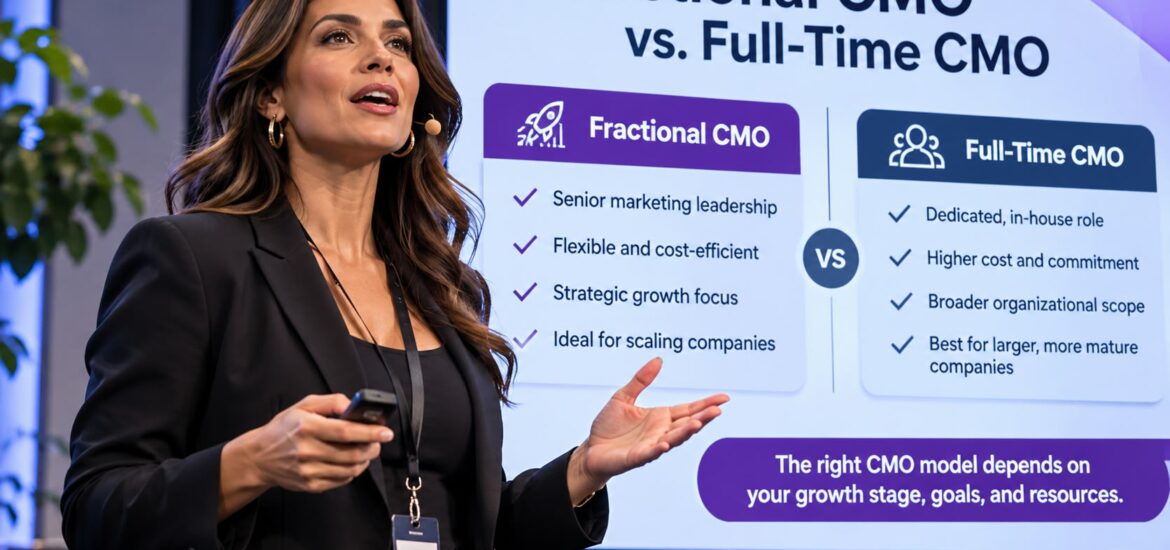
In the contrast between a fractional CMO and a full-time marketing executive, a fractional CMO leads strategy, sets the plan, and brings in or hires the right people to execute the tactics. While an agency works on your behalf, an in-house team is you, and a fractional team is led by someone who defines the role and determines what needs to get done, finding the right people to accomplish those tasks. A full-time executive possesses day-to-day execution, team development, and culture over the long term. Fractional leaders focus on priority areas such as positioning, yield management, event packages, and audience segmentation, while full-time leaders bring ongoing supervision, team mentoring, and stronger interdepartmental connections. Studies indicate that a poor executive hire can set you back three to five times their salary, and fractional engagements mitigate that hiring risk, making them a smart choice for companies looking to optimize their marketing function.
Emphasizing the agility, resilience, and cost-effectiveness of the fractional model for event venues is crucial. Fractional CMOs allow venues to acquire senior-level expertise without taking on a full salary and benefits burden. This model is particularly suited for spaces requiring quick hacks or growth sprints and can save significant dollars during the initial six to twelve months. Fractional work can scale up or down as bookings shift, and engagements can be exited or paused within months, not years. For venues with seasonal demand or uncertain recovery curves, that adaptability keeps budgets lean while maintaining a clear strategy for business growth.
Talk about differences in dedication, supervision, and connection with the leadership team. Full-time executives offer deep immersion and a constant presence, usually needing three to six months to ramp up to maximum impact. They deliver constant management and deal with the cultural problems that define a long-term strategy. Fractional CMOs need clear scorecards and a plan with a single owner to prevent gaps. They need strong point people inside the venue for implementation. Oversight in the fractional model is more project-based and outcome-focused. Fractional works best when the team is early or mid-stage, while in-house is preferable when the team is mature and needs a steady leader.
Creating a pro/con table for each of the leadership structures can be beneficial. The table should list criteria such as cost, ramp time, integration, scalability, risk of bad hire, execution depth, and accountability. For each row, note quantitative estimates where possible: expected ramp time is three to six months for full-time, typical engagement length is six to twelve months for fractional, and risk exposure is higher for a full hire. Consult this table to map the decision to your business needs, growth goals, and team maturity.
Hiring Steps
Hiring a fractional chief marketing officer for an event venue begins with a defined brief that outlines objectives, timeline, and budget. To ensure effective business growth, quantify three to five outcomes, set two budgets: the CMO fee and an execution budget for media, tools, content, agencies, or hires. Additionally, selecting an engagement model is crucial before sourcing candidates. A targeted search typically requires a few weeks once the scope is prepared, with expert search firms locating passive senior candidates more rapidly than LinkedIn alone.
Assess Needs
-
Increase bookings by X% within 12 months
-
Improve average event spend by Y currency units
-
Increase website to booking conversion rate from A percent to B percent.
-
Set up a 90-day lead nurture program and CRM.
-
Provide a content calendar, a paid media schedule, and a vendor brief.
Begin with an internal audit that maps existing channels, conversion points, customer segments, and vendor relationships. This marketing approach will help clarify the scope: owned media, paid campaigns, partnerships, or venue experience changes. Match the position to the growth stage, as early-stage venues require business growth strategies like growth hacking, while mature venues might need a brand refresh and partnership deals. Revisit the priority list and have your stakeholders agree on which outcomes are core.
Interview Leads
Prepare targeted questions that probe strategy, process, and measurable results: ask about a past venue or hospitality win, the specific steps taken, and the metrics improved. Consider success stories and related industry experience, but favor strategic process and leadership depth above a polished resume. Include a real problem in the interview: give a brief and ask for a 30 to 90 day plan to see thinking and pace. Evaluate cultural fit and communication style with the venue’s team via a panel or working session. Create an interview scorecard to compare candidates: include categories for domain experience, leadership, communication, technical skills, and expected 90 day outcomes. Conduct reference checks with former CEOs and clients to confirm decision rights the candidate had and whether they delivered on agreed outcomes, ensuring they possess the necessary skills for business growth and a clear strategy for tackling challenges.
Structure Terms
Outline key contract elements for your marketing team: clear scope, deliverables, time allocation, decision rights, compensation model, and termination terms. Define performance metrics and reporting cadence to ensure effective tracking of results. Monthly reporting and a formal 90-day review are typical for assessing the impact of your marketing strategies. Make terms flexible so the scope can shift as business needs evolve, particularly during expansion phases. Have change-order rules in place and a path to grow or shrink hours as required. Create a general template agreement on scope, a written 90-day plan, and clear metrics for success to ensure alignment with your company’s goals.
Conclusion
Fractional CMO for Event Venues
A fractional CMO provides event venues targeted marketing expertise without the expense of a full-time employee. They schedule campaigns that generate consistent bookings, optimize pricing for greater margins, and establish easy-to-reference metrics to demonstrate growth. One venue we worked with, for instance, that used targeted email and local partnerships experienced a 30% increase in weekday bookings in three months. Another venue reduced ad waste by 40% after a fast audit and clearer audience maps.
Select a venue expert as your fractional CMO. Start with a brief pilot project, follow measurable metrics, and meet weekly to keep work on track. Ready to try a fractional CMO at your venue? Contact us to schedule a pilot that suits your timeline and budget.
Frequently Asked Questions
What is a fractional CMO for event venues?
A fractional chief marketing officer is a senior marketing leader who collaborates part-time with an event venue, providing strategic flexibility, team direction, and tactical execution support at a fraction of the cost of a full-time executive.
How can a fractional CMO boost venue bookings?
They build pipelines via marketing strategies, digital presence, and lead conversion, driving more qualified inquiries and lessening the sales cycle.
When should an event venue hire a fractional CMO?
Hire when you need strategic marketing leadership on a fractional basis, perfect for business growth, rebranding, or addressing leadership gaps in your marketing department without the cost of a full-time salary.
What specific deliverables will a fractional CMO provide?
Common deliverables include marketing strategies, KPI dashboards, and vendor selection guidance, all crucial for business growth and digital transformation.
How does a fractional CMO differ from a marketing manager?
A fractional chief marketing officer (CMO) focuses on strategy, leadership, and cross-functional alignment, while a marketing manager oversees day-to-day execution and campaigns, ensuring effective marketing strategies.
How much does a fractional CMO cost?
Pricing for a fractional chief marketing officer depends on experience and scope, so discuss your specific projects to receive an accurate quote for your venue.
How do I evaluate a fractional CMO for my venue?
Seek events or hospitality experience, demonstrated ROI examples, and solid communication skills for the marketing team. Set KPIs and request a 90-day plan with concrete goals for business growth.